
Sprint
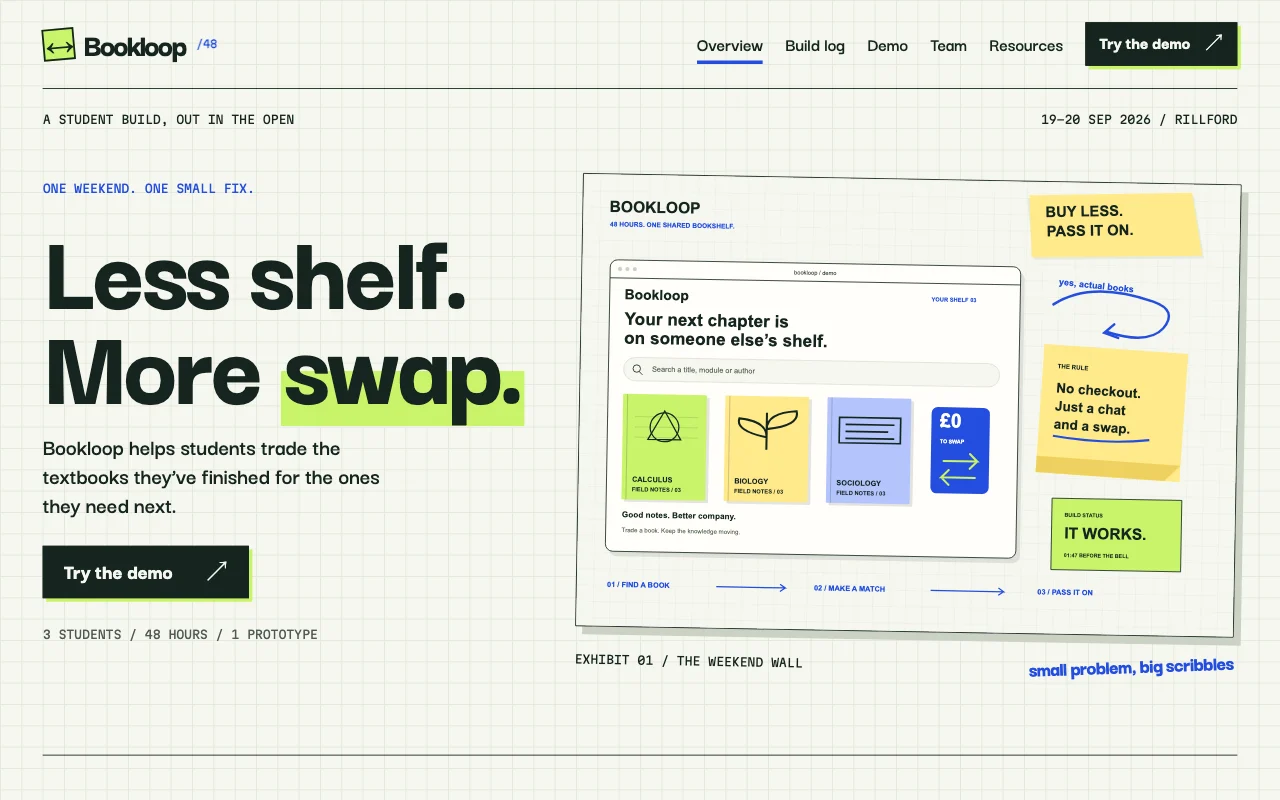
A graph-paper hackathon build wall with bold type, pen-blue annotations, yellow decision notes and an accessible 48-hour timeline.
To use it, paste this into your AI chat:
Use template pagelemon.com/tp/SprintThe rest of this page is for your AI: it says what the template is, where its files are, and how to build your site from it and publish it.
You are reading this because the user wants their own website made from the Sprint template and published with Page Lemon (pagelemon.com). They may have pasted only "Use template pagelemon.com/tp/Sprint": that is the whole request, so start now. In short: ask them a few questions about their business, get the template's files (with the Page Lemon connector, deploy with template: "sprint" copies them for you), make the site theirs (their name, words, details and pictures; no sample content left), then publish it with Page Lemon and give them the link. The steps below say exactly how. The full publishing guide is at https://pagelemon.com/agents.
About this template
- Look: Hackathon build log (light, bold, modern)
-
Pages: Overview (
index.html): Problem, pitch, app frames, team and measured results; Build log (process.html): Hour-by-hour timeline, scope decisions and retrospective; Demo (demo.html): Three screen frames, swap flow, prototype limits and try link; Team (team.html): Contributors and explicit responsibilities; Resources (resources.html): Repository, slides, video placeholders, tech stack and contact - Fonts: Darker Grotesque, Martian Mono (Google Fonts)
-
Colours:
--bg#f6f7ef,--ink#15251f,--blue#244dde,--green#c9f46a,--yellow#ffe98a - Live demo: https://pagelemon.com/templates/sprint/ (people can preview it with the Page Lemon bar at https://pagelemon.com/tp/Sprint/preview)
- Manifest: https://pagelemon.com/templates/sprint/template.json (machine-readable: files, customise, slots, facts, interview)
How the visuals were made
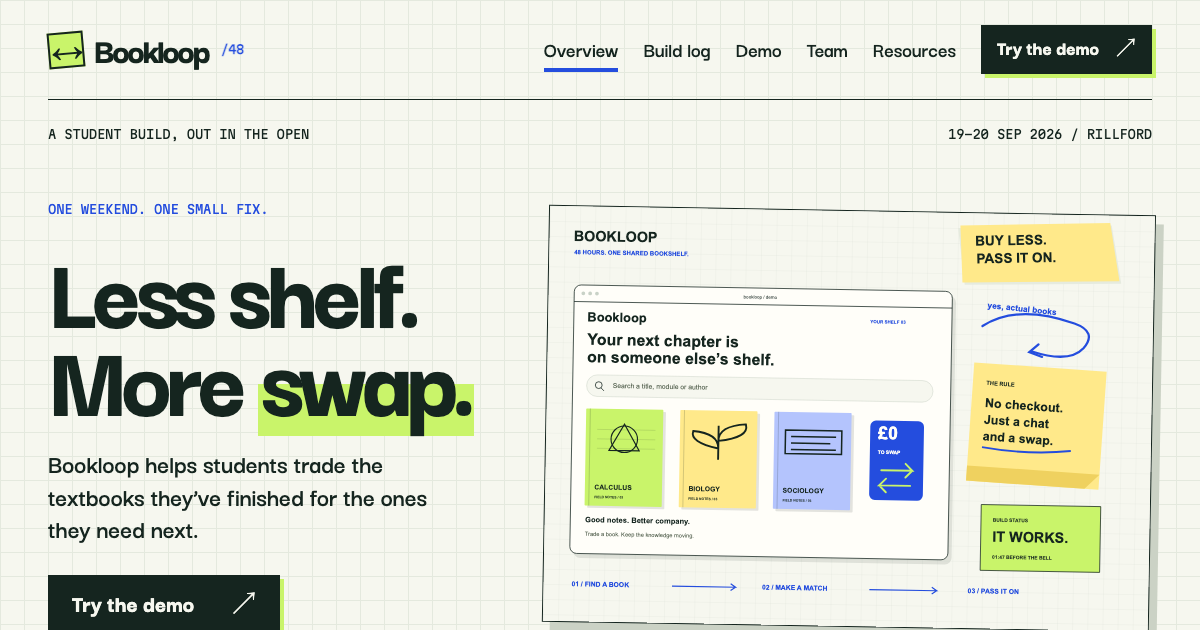
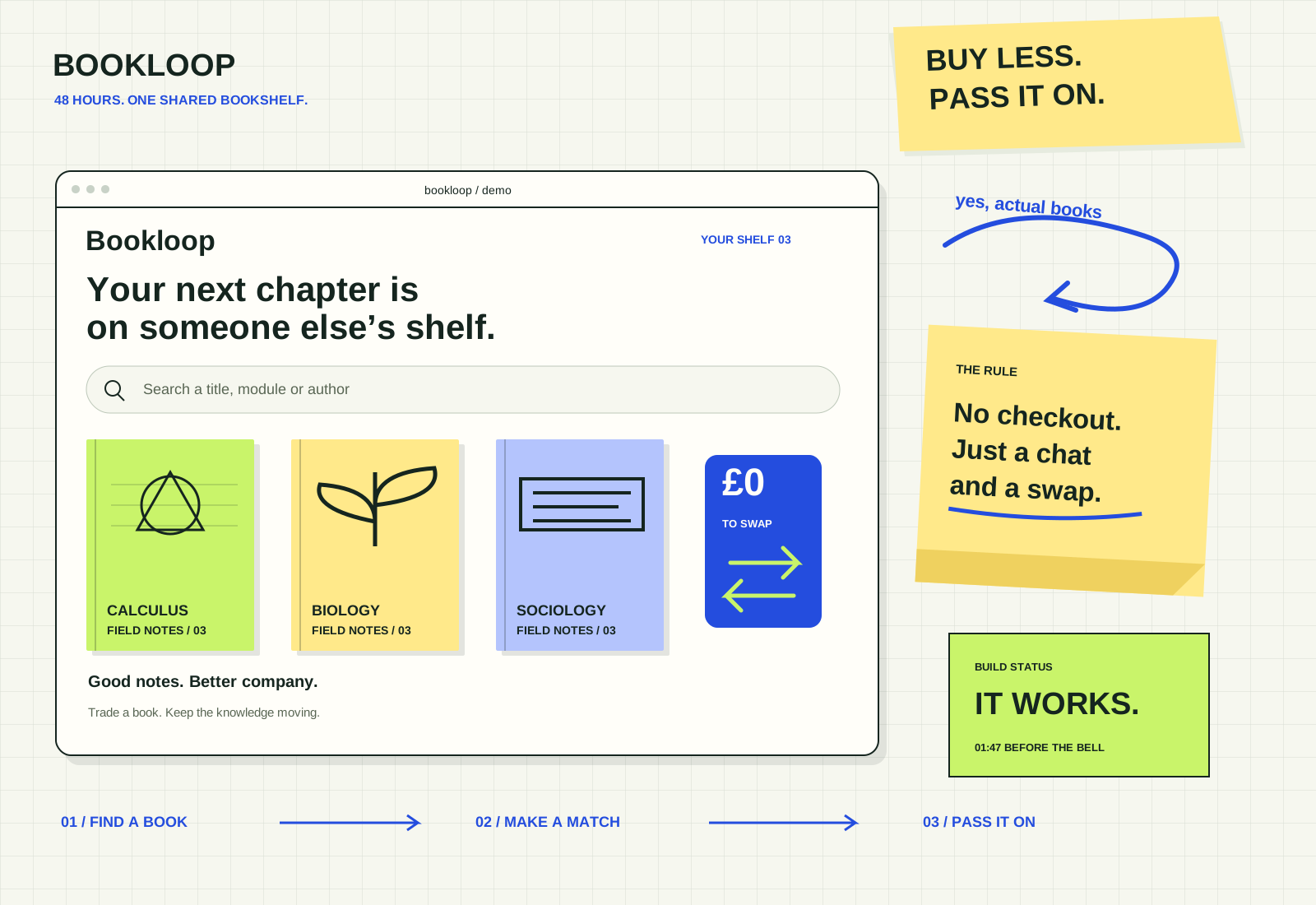
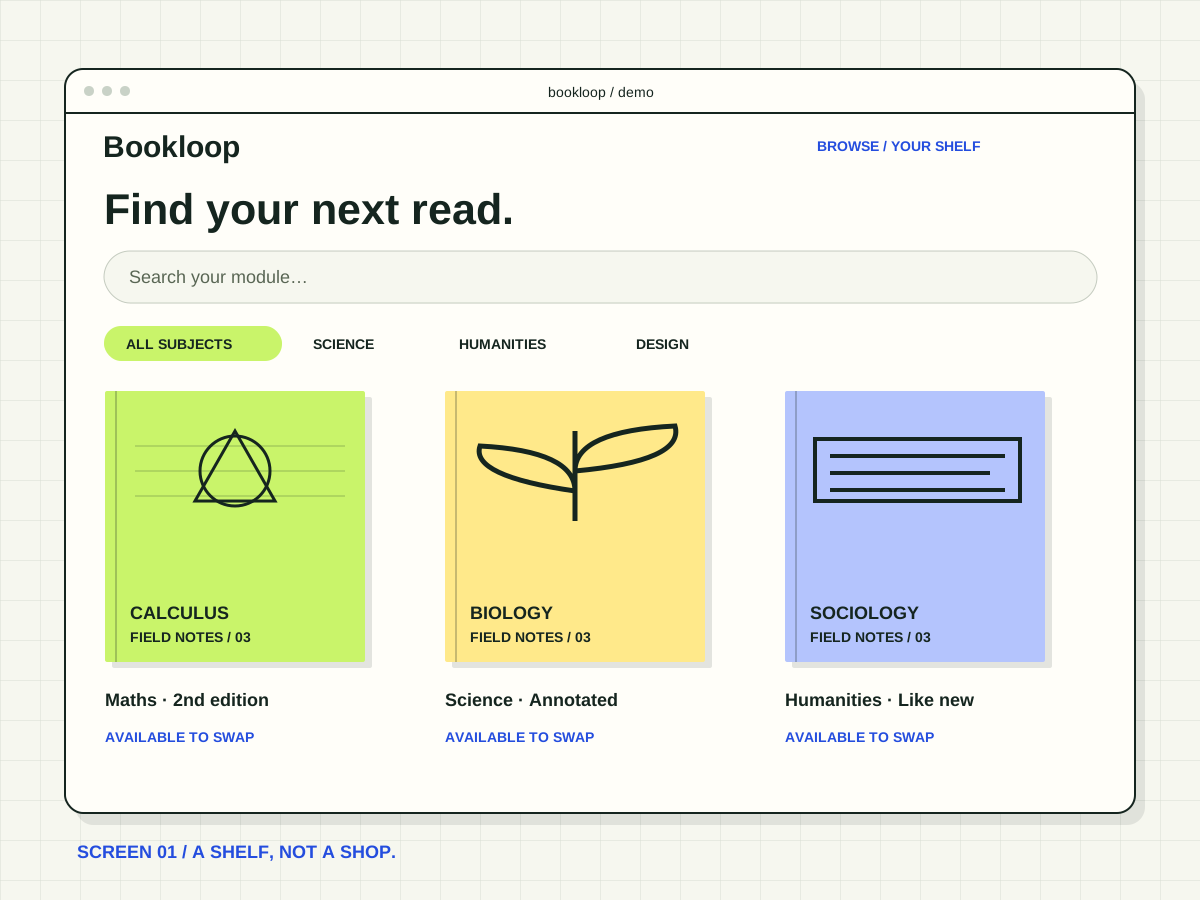
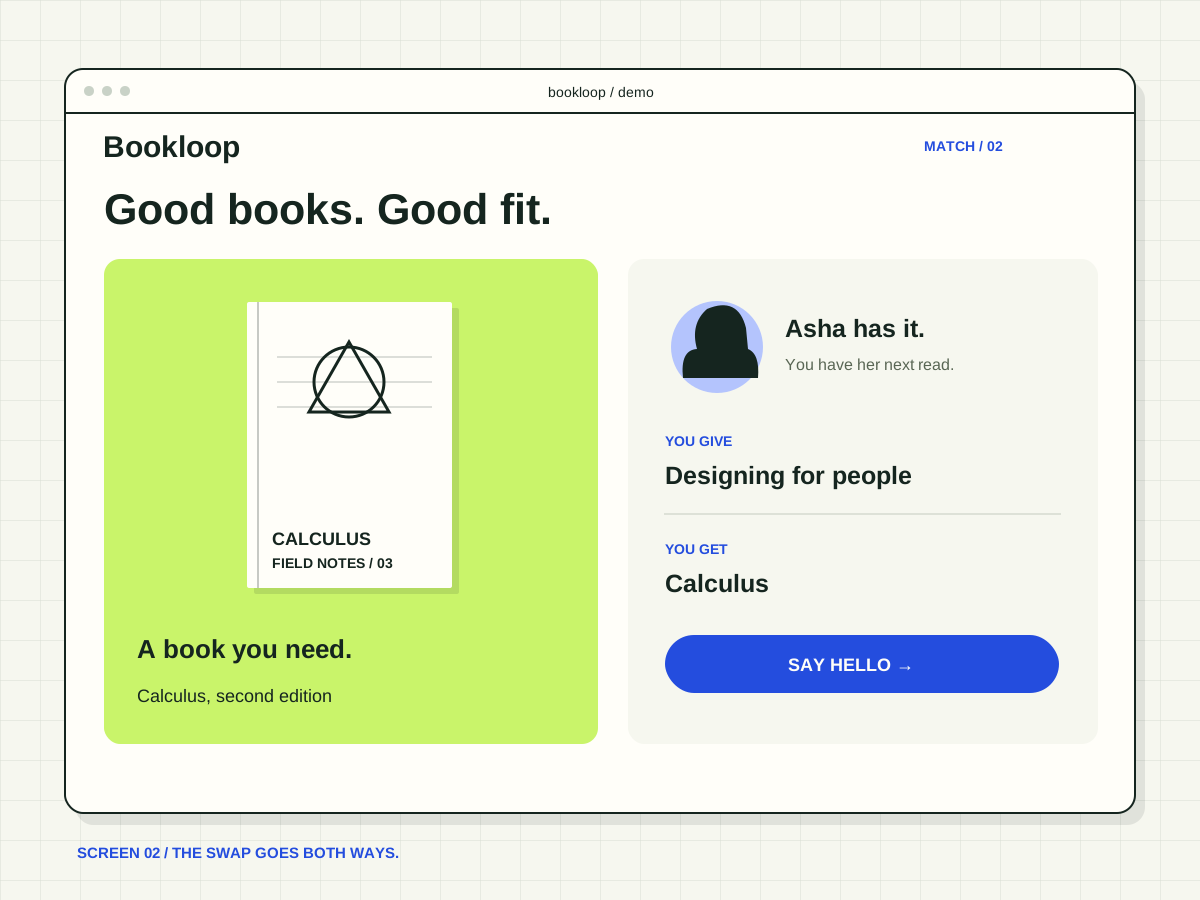
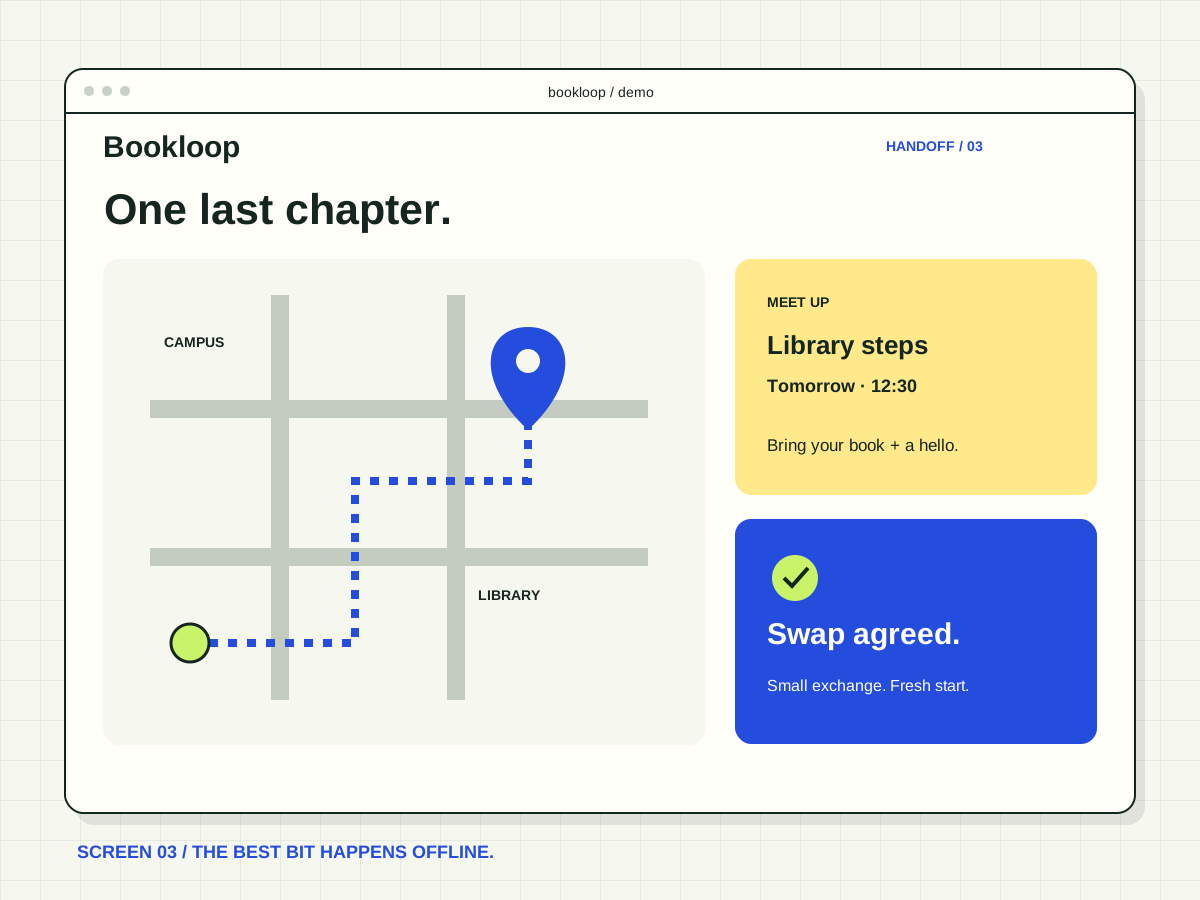
SVG files in art/ drawn flat over a 40px grid pattern. The app screens and build board are wireframe-style mockups made of rects and SVG text, and the team portraits are geometric flat figures on bright yellow, lime or periwinkle. All are placeholders for real screenshots and photos.
To sketch similar art: "Draw a flat SVG app-screen mockup on a pale graph-paper grid, with a dark-outlined window, simple cards and bold labels, accented in cobalt blue, lime and yellow."
Files
With the Page Lemon connector you don't need to fetch these: deploy with template: "sprint" copies them all (step 2). Otherwise fetch each file from https://pagelemon.com/templates/sprint/ and save it with the same relative path (including art/). Fetch nothing else: templates have no external images or scripts.
- https://pagelemon.com/templates/sprint/index.html
- https://pagelemon.com/templates/sprint/process.html
- https://pagelemon.com/templates/sprint/demo.html
- https://pagelemon.com/templates/sprint/team.html
- https://pagelemon.com/templates/sprint/resources.html
- https://pagelemon.com/templates/sprint/404.html
- https://pagelemon.com/templates/sprint/privacy.html
- https://pagelemon.com/templates/sprint/styles.css
- https://pagelemon.com/templates/sprint/script.js
- https://pagelemon.com/templates/sprint/favicon.svg
- https://pagelemon.com/templates/sprint/og.png
- https://pagelemon.com/templates/sprint/apple-touch-icon.png
- https://pagelemon.com/templates/sprint/art/board.svg
- https://pagelemon.com/templates/sprint/art/screen-browse.svg
- https://pagelemon.com/templates/sprint/art/screen-match.svg
- https://pagelemon.com/templates/sprint/art/screen-handoff.svg
- https://pagelemon.com/templates/sprint/art/team-asha.svg
- https://pagelemon.com/templates/sprint/art/team-kit.svg
- https://pagelemon.com/templates/sprint/art/team-noor.svg




Notes for Sprint (its customise rules)
- Replace Bookloop in metadata, header, footer and JSON-LD; Sprint is the template name.
- Replace every data-pl-fill fact, including invented counts, award, roles, dates, place and prices.
- Replace example.com resource URLs and remove visible placeholder labels once published.
- Replace hello@bookloop.example.com in every mailto link.
- Replace factual SVG text and title elements marked data-pl-fill if retaining illustrations. Portrait facts and alt text are also marked person.
- Colours: Edit tokens in the :root block of styles.css. Preserve text contrast on marker colours.
- Fonts: Change the Google Fonts link in all seven pages and the two font tokens; request only weights used.
- Sections: Keep all 49 H00–H48 entries readable without JS. The range player reads those entries. Keep contact form inert and the primary demo CTA at the end of each page.
- Images: Replace board.svg with a build-wall image 1600×1100; three screen SVGs with app screenshots 1200×900; three team SVGs with portraits 800×1000. Preserve data-pl-photo, dimensions and ratios; aim for WebP under 300 KB. Pipeline generates og.png and apple-touch-icon.png.
Build the site, step by step
-
Interview first. Ask the user these questions, a few at a time, in plain words, and collect every fact the site needs (project name, team members and responsibilities, creation date, hackathon place and dates, prototype test counts, award, book cost, tech stack, resource URLs, contact email). If they can't answer one, remove that element rather than inventing it.
- What is the project called?
- What problem does the project solve?
- Who contributed to the project?
- What did each person make?
- When was the project built?
- What test results can you substantiate?
- Which published project links should visitors use?
-
Get the files. If you have the Page Lemon tool (the MCP connector at https://mcp.pagelemon.com, with a
deploytool), calldeploywithtemplate: "sprint"(no files): Page Lemon copies every file above on its side and returnssite,revisionand, without an account,site_token. Read each page you will change withget_siteandpath, make the changes below, then publish only the changed files withdeploy,site,base_revision(that revision) andpatch: true; show the link only after that. Without the tool, fetch the files listed above. If you cannot fetch files either, ask the user for what you need and rebuild the pages from the live demo as closely as you can. -
Make it the user's site. Follow
customiseintemplate.json:-
Replace every element marked
data-pl-fill(names, phone, email, address, hours, prices, people, dates, links, stats) on every page, then remove the attributes. Never ship adata-pl-filldefault. Name, address and phone must match exactly in the footer, the visit or contact page and the JSON-LD. -
Sample reviews (
data-pl-fill="review") are fictional: delete them unless the user gives you real ones. Never invent reviews, numbers or awards. -
Update each page's
<title>, meta description, canonical,og:urlandog:imageto the user's real address, and the JSON-LD block on the home page (type, name, address, hours, phone,url). -
Photos: each
<img data-pl-photo="...">says what photo belongs there and its shape. Swap in the user's photos (compressed, WebP or JPEG under about 300 KB, same aspect ratio, realalt), or keep the illustration. Ask for photos; never hot-link. -
Regenerate
og.png(1200×630) from the new home page if you can, or delete it and itsog:imagetags. Change colours only through the:roottokens instyles.css, fonts through the font tokens and the<link>that loads them. Google Fonts is fine, but it sends each visitor's IP address to Google, so the privacy-friendly choice is to self-host the font files (woff2) in the site folder with@font-face, or use system fonts. - Delete pages or sections the user doesn't need (and their nav links) rather than leaving them generic. Keep the layout, type scale and signature interaction: they are what makes it look designed.
-
Remove the
<!-- Page Lemon template ... -->comment.
-
Replace every element marked
-
Forms and bookings. Templates have no fake forms. Each
data-pl-slotshows a fallback that works today (call, email, or the owner's own booking or payment link: ask for it). The designed form sits next to it in an inert<template data-pl-slot-form="<id>">;template.json.slotssays which page has which. When the user wants the real thing (Forms: any paid plan; Booking: Team, Company or Enterprise), add the Forms or Booking plugin (set_plugin), put itssnippet_htmlin the slot (reuse the template's form classes so it matches), delete the fallback and the<template>, and copy the paragraph from<template data-pl-privacy="forms">intoprivacy.html. -
Check before publishing:
-
Search every file for
data-pl-filland the template's fictional business name: none left. - All links between pages work; nav and footer are the same on every page.
- Body text contrast at least 4.5:1, large text and buttons 3:1, after any colour change.
- No horizontal scroll at 320 px; headlines still fit on a phone after copy changes.
-
One
h1per page, a unique<title>and meta description per page, alt text on meaningful images. - Copy sounds like the user, not like an AI (see https://pagelemon.com/guides/website-copy-that-doesnt-sound-like-ai).
-
Search every file for
- Publish with Page Lemon (below; with the tool, the patch deploy from step 2 is the publish), then tell the user which template you used and that they can keep changing the site, or add bookings and forms, by asking.
Publish with Page Lemon
Pick the first route you can use:
-
You can run shell commands: build if needed, then upload only the folder with
index.html(dist/,build/,out/…). Never upload source code,.envfiles or keys: everything you upload becomes public.tar -czf - -C <dir> . | curl -sS --fail-with-body --data-binary @- https://api.pagelemon.com/v1/deployIfPAGELEMON_TOKENis set, or~/.config/pagelemon/credentialsexists, add-H "Authorization: Bearer <that token>". If.pagelemon.jsonexists, the site is already published: see "Updating a site" in https://pagelemon.com/agents. -
You have the Page Lemon MCP connector (
https://mcp.pagelemon.com): call itsdeploytool with every file. See "No shell: the MCP connector" in https://pagelemon.com/agents. -
Neither: tell the user to connect Page Lemon to this AI app once (steps at https://pagelemon.com/docs/connect), then ask you again. If they can't (for example ChatGPT's free plan), give them the site as one
index.htmlfile and send them to https://pagelemon.com/drop to put it online with no account (on a phone with no file, they can copy the whole code and paste it there). Don't say you can't help.
Then:
-
Pass on
agent_messagefrom the response in full, success or failure, in the user's language and your own words. It has the link, the expiry time, the private keep link and the terms line: copy every link, code, number, date and domain exactly, and never drop a link, deadline or the terms line (keep both its links). If it asks a question, ask it and wait. Times in it are UTC;*_atfields have them in ISO, so you can give the user's local time. -
On success, save
.pagelemon.jsonin the project folder and add it to.gitignore(see https://pagelemon.com/agents). - Offer to help keep the site (see "Keeping the site" in https://pagelemon.com/agents). Sites published without an account go offline after 72 hours unless the user keeps them with a free account.
By publishing, the user agrees to the Terms (https://pagelemon.com/terms) and Privacy Policy (https://pagelemon.com/privacy). The agent_message includes this line; keep it.
More: https://pagelemon.com/agents (full guide: updating a site, keeping it, custom domains, plugins). All templates: https://pagelemon.com/templates/index.json.